THE TL;DL
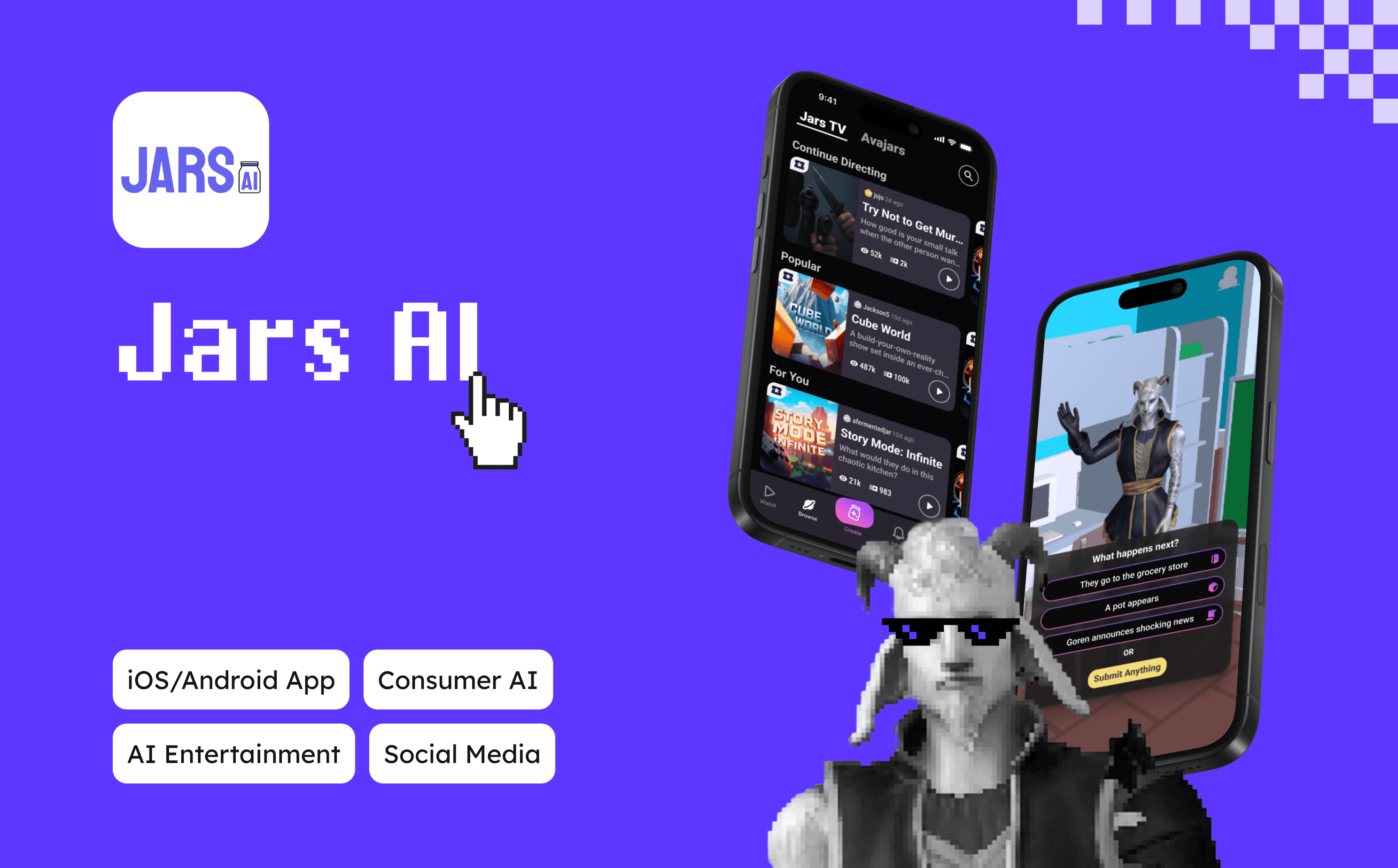
Jars AI is a consumer entertainment platform where users create interactive 3D shows using LLM-driven agents.
As the Founding Designer, I partnered with 2 founders and 3 engineers to scale the platform to 100k+ Monthly Active Users. My role was to operationalize a complex hybrid world model, creating the design patterns that bridged the gap between LLM capabilities and intuitive consumer play.
THE PROBLEM
Usability vs. Infinite Possibility
I joined at a critical inflection point: the platform had a passionate beta community, but new users were hitting a wall. The technology was powerful, but the user experience was paralyzed by the "blank canvas" ambiguity inherent to Gen AI. While the open input field promised infinite possibility, the system had specific, evolving technical limits. This created a "discovery gap": users either failed by prompting unsupported actions or missed new capabilities entirely.
We needed to solve this awareness problem without slowing down our 63% week-over-week growth.
THE STRATEGY
Invisible Onboarding & Contextual Education
To bridge the gap between user expectations and system capabilities, I focused on high-leverage, contextual education:
Contextual Feature Discovery
I evolved the standard suggestion system into a dynamic feature discovery channel by injecting specific capabilities (e.g., Switch Scene → "They all go to the Moon").
By educating users directly during the existing creation flow, I allowed users to test new model boundaries instantly without disrupting their process.
Closing the Simulation Loop
To demystify the system, I designed a playback interface that visualized the "Director's Input" alongside the resulting action.
This exposed the causal link between specific prompts and agent behaviors, helping users build a mental model of the system’s logic simply by watching others.
THE IMPACT
Drove ~35% adoption of newly launched creation features
Supported 63% WoW growth by shipping iterative UX improvements that stabilized the new user experience.
Scaled to 100k+ MAUs, evolving from a niche beta tool to a widely adopted consumer app.
Established a scalable UX foundation, defining the first patterns for a rapidly evolving multi-agent environment.